
Focus & energy

How to plan your week around your energy, not just your time

A perfect schedule that ignores your energy falls apart by Wednesday. Here is how to plan around the energy you actually have, so the week survives contact with reality.

Aleem O'BalogunBy Aleem O'BalogunUpdated 6 min read

The short answer

Planning around your energy means placing demanding work where your focus and energy are reliably higher, and lighter tasks where they dip, instead of treating every hour as identical. Time is not the only constraint; a plan that ignores energy is a wish list with timestamps. Matching the work to the energy is what makes a week hold together.

Steps

  1. 1

    Notice your own energy pattern

    Over a week or two, note when your focus is reliably high, when it dips, and when you are running on empty. You are looking for your rough pattern, not a precise measurement.

  2. 2

    Match demanding work to your peaks

    Put the hard, focus-heavy work in your reliably high windows. Save the low windows for admin, errands, and things that do not need much of you.

  3. 3

    Plan for the energy you will have, not the ideal

    Some days and weeks are just lower. Plan a lighter version for those rather than a heroic one you will abandon.

  4. 4

    Protect recovery on purpose

    Rest is not the absence of a plan; it is part of one. Leave genuine gaps, because a week with no recovery borrows energy from the next one.

Time is not your only constraint

Most planning treats every hour as identical: a free slot is a free slot, and any task can go in it. Anyone who has tried to do serious thinking at four in the afternoon knows this is not true. An hour when your focus is sharp and an hour when you are running on fumes are not interchangeable, and a plan that pretends they are will quietly fail.

Energy is the missing constraint. You do not just have a certain number of hours; you have a certain amount of good attention, and it is unevenly distributed across the day and the week. Planning around your energy, not just your time, is what separates a schedule that looks good on paper from one that actually survives the week.
How to plan around your energy

You do not need to track anything precisely or treat this as a science. You just need your rough pattern, most people know when they are sharp and when they fade, and a habit of placing work accordingly.

  • Peaks for hard work: put focus-heavy tasks in your reliably high windows
  • Dips for light work: admin, errands, and low-stakes tasks when energy fades
  • Plan the realistic version: a lighter week when you know energy is low
  • Protect recovery: leave real gaps, because rest is part of the plan, not a failure of it

Energy across the whole week, and the whole of life

Energy is not only a daily rhythm; it runs across the week and across the parts of your life. A brutal work stretch leaves less for training and the people you care about, whether or not the hours are technically free. Planning as though those hours are fully available, just because nothing is scheduled in them, is how people end up depleted while their calendar looks fine.

Planning around your energy across the whole of life means letting a heavy week in one area visibly lighten the others, rather than stacking demands on top of each other because they do not clash on the clock. The time can be free while the energy is not, and a plan worth keeping knows the difference.

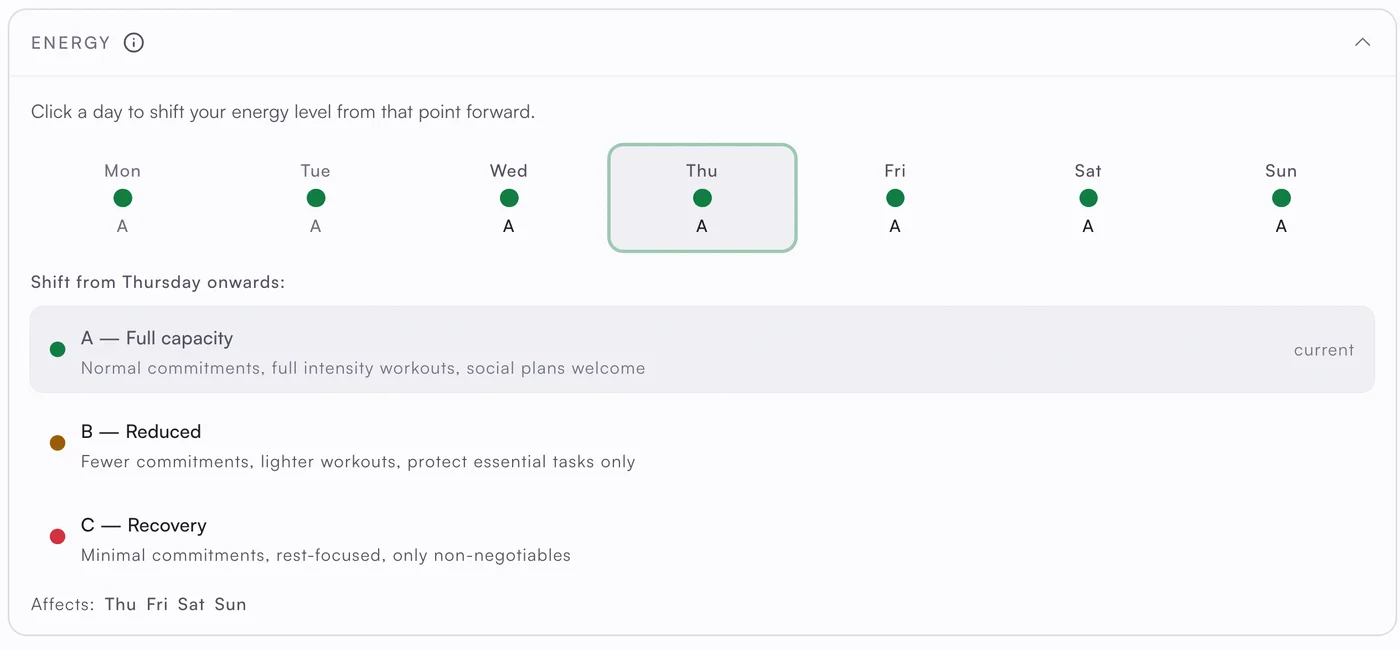
asambl's energy panel: each day of the week set to a tier, with Thursday onwards shifted between Plan A full capacity, B reduced, and C recovery. It is a setting you control, not a measurement.
Plan A, B, C: scale the week to the energy you have

Where asambl fits

asambl is a private weekly planner for macOS and Windows that plans with energy in mind, not just time. It places demanding work where your energy is reliably higher, keeps the whole of life in view so a heavy stretch in one area eases the others, and offers a Plan A, B, C view so you can scale the week to the energy you actually have on the day rather than an ideal one. You review and approve the draft; nothing lands until you do.

The energy tiers are a planning tool, a setting you control, not a measurement of you, and you can adjust or ignore them. Your plans stay on your own computer as portable files, and the drafting can be switched off if you would rather plan by hand.

Plan A, B, C

One week, three sizes

The same week at each tier. The fixed commitments never move; the tiers only change what is asked of you around them, and a lower tier only ever takes things away, never adds.

Plan A · Full capacity

The full week, full intensity

  • MonWorkStrengthDinner: Daniel
  • TueWorkEasy runSpanish
  • WedWorkDeep work: pitch
  • ThuWorkPub quiz
  • FriWorkTempo runCinema
  • SatLong run 16kmDrinks: Ruth
  • SunMoney hourCall: MumPlan the week

Plan B · Reduced

Fewer commitments, easier sessions

  • MonWorkStrength, easyDinner: Daniel
  • TueWorkEasy runSpanish, 20 min
  • WedWorkDeep work: pitch
  • ThuWork
  • FriWorkEasy runCinema
  • SatLong run 10km
  • SunMoney hourCall: MumPlan the week

Plan C · Recovery

Essentials only, rest on purpose

  • MonWork
  • TueWorkShort walk
  • WedWorkDeep work: pitch
  • ThuWork
  • FriWork
  • SatWalk + coffee
  • SunCall: MumPlan: 10 minutes

Grey blocks are fixed commitments; coloured blocks are the chosen layer. Drop the tier and the chosen layer thins while the essentials survive. The tiers are a dial you set, not a measurement of you.

The fastest way to judge the method is to watch it run.

See it through a real week

Plan the week before it starts

A short prompt every Sunday to help you decide what next week is actually for, plus the occasional essay. No product pitch, unsubscribe any time.