
Planning & review

How to do a weekly reset (and start the week actually ready)

The reset is the transition: close the week that ended, clear what piled up, and hand a clean slate to the plan. Three sizes, one checklist, and the failure modes that kill the habit.

Aleem O'BalogunBy Aleem O'BalogunUpdated 7 min read

The short answer

A weekly reset is the transition ritual between weeks: 20 to 40 minutes to clear the places things piled up, close the week that ended (finish, carry, or let go), make next week's start easy to begin, and hand over to the planning pass. It is about state, not the day: run it whenever your week actually turns.

Steps

  1. 1

    Clear the inputs

    Empty the places things pile up: inbox, notes app, camera roll, the scraps on your desk. You are not doing the work, just getting everything into one place so nothing important is hiding when you plan.

  2. 2

    Close the week

    Give the week that ended a clean edge: mark the finished things finished, carry the unfinished forward with a note, and let go of what stopped mattering. For the proper learning look-back, the weekly review is this step done deeply.

  3. 3

    Make the start easy

    Ten minutes of making-ready, capped: the first thing you will work on findable, the desk and desktop clear enough not to argue with you, the one errand that unblocks the week done or scheduled.

  4. 4

    Hand over to the plan

    The reset clears the ground; the planning pass builds on it. Choose priorities and block time using the weekly method, which is its own guide because it is its own skill.

What a weekly reset actually is

A weekly reset is the transition between one week and the next: a short routine that closes the old week on purpose and leaves the new one easy to start. It is not the planning itself, and it is not the deep look-back; it is the clean edge between them. Most weeks do not go wrong because of one big failure. They drift, because nothing ever gets closed and nothing gets made ready, and Monday inherits an open tab of a life.

One boundary to draw early, because the internet blurs it: the reset is about state, not the day. Sunday is the most popular home for it, and planning on a Sunday has its own guide about the timing and the feel of that ritual. This page is the system underneath, whichever day your week actually turns; shift workers and freelancers reset on Wednesdays and lose nothing.
The three sizes of reset

One routine, three sizes. Knowing all three matters, because the ten-minute version is what keeps the habit alive in the weeks that would otherwise kill it.

SizeWhenWhat it covers
10-minute emergency resetMid-chaos, or after a week that fell apartClear your head into one note, make one carry-or-drop decision, put tomorrow's first thing where you will trip over it. Nothing else
30-minute weekly resetOnce a week, at your week's real turning pointThe four steps above in full: clear, close, make ready, hand over to the planning pass
60-minute deep resetRoughly monthly, or after travel or illnessThe weekly reset plus the drift sweep: the areas a busy month ignored, the routines that quietly died, the piles that outgrew their homes. This is the monthly rung of the cadence ladder wearing work clothes
Pick the size the week deserves, not the size ambition suggests

The 30-minute version, step by step

The standard reset, run calmly in the same slot each week so it stops costing willpower:

  • Clear: empty your inbox, notes, and the scraps into one place (10 minutes, timer on)
  • Close
    • finished things marked finished
    • unfinished carried forward with a note
    • the dead let go without guilt (10 minutes)
  • Make ready
    • next week's first task findable, the surfaces clear enough, the unblocking errand handled (capped at 10 minutes
    • making-ready is where resets go to die)
  • Hand over: open the planning pass and choose the week, using the method that has its own guide
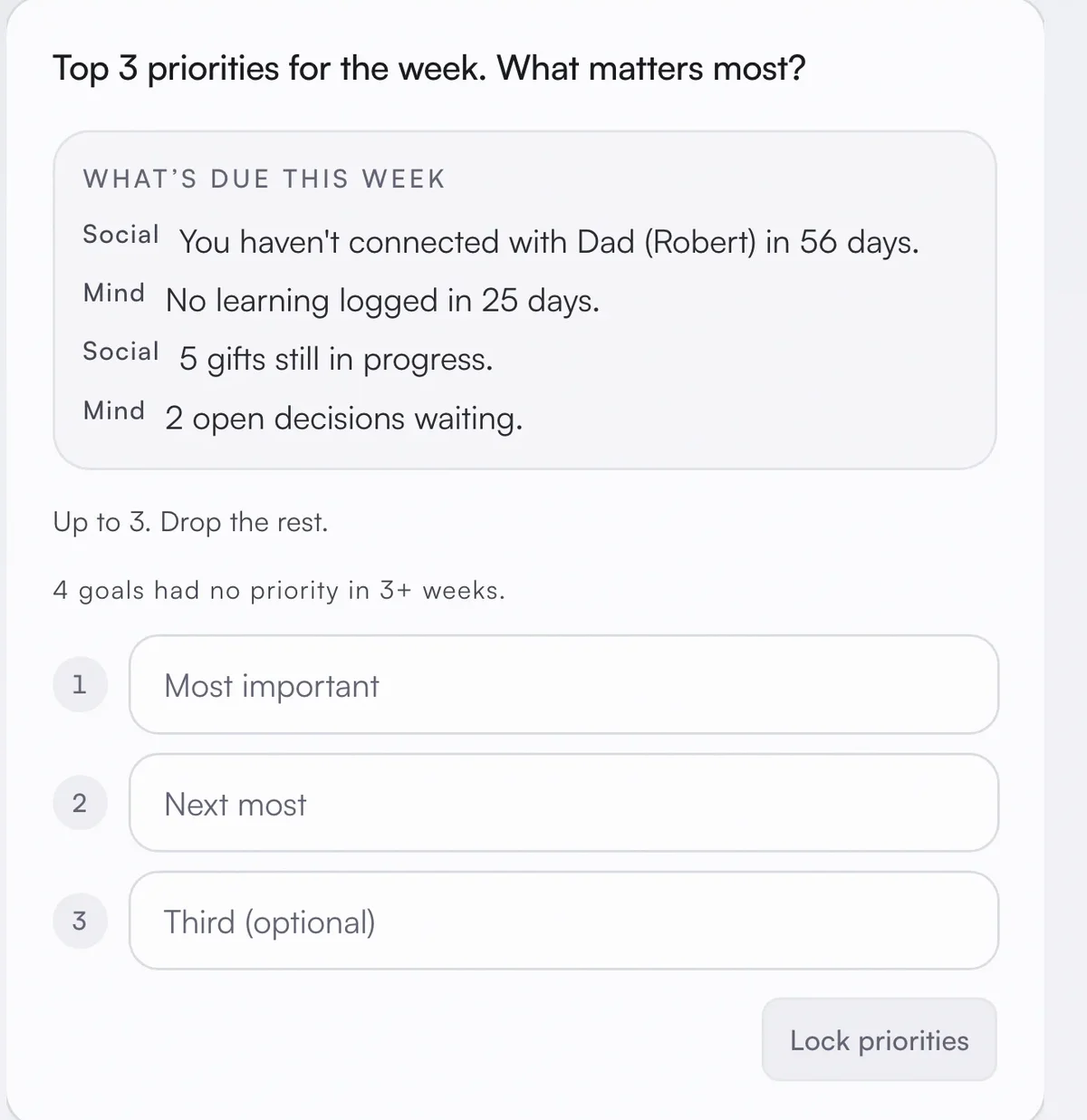
asambl's weekly reset asking for your top three priorities, with what is due this week shown alongside: an overdue catch-up, learning, and open decisions, so nothing important is out of sight.
The handover: the reset done, the plan being chosen

Where resets fail

The reset has five known failure modes, and every abandoned reset habit died of one of them:

  • Doing the work instead of closing it: the reset is for deciding what carries, not for finishing tasks; the moment you start replying to emails, the reset is over
  • Tidying forever
    • making-ready is capped at ten minutes for a reason
    • a spotless desk at the cost of an unplanned week is a loss dressed as a win
  • Transferring the whole backlog: moving every unfinished item into next week is not closing the week, it is re-scheduling guilt; carry, resize, or let go, deliberately
  • Smuggling in the planning
    • choosing twelve priorities during the reset because you are already sitting there
    • the reset hands over to the plan, it does not replace it
  • The Monday fresh-start fantasy: a reset gives the week a clean edge, not you a new personality; expect a clear start, not a transformation, and the habit survives contact with real Mondays

The checklist, as a file

All three sizes on one page, ready to copy into any notes app or print. Free, like every template in this library.

The weekly reset, all three sizesreset-checklist.md · free to copy, yours to keep
# The weekly reset

## 10-minute emergency reset (mid-chaos re-entry)
- [ ] Head cleared into one note, everything, no sorting
- [ ] One decision: what carries, what drops
- [ ] Tomorrow's first thing, placed where I will trip over it

## 30-minute weekly reset (the standard)
Clear (10 min, timer on)
- [ ] Inbox, notes app, camera roll, desk scraps: into one place
Close (10 min)
- [ ] Finished marked finished
- [ ] Unfinished carried forward, each with a one-line note
- [ ] Dead items let go, without guilt
Make ready (10 min, capped)
- [ ] Next week's first task findable
- [ ] Surfaces clear enough not to argue with me
- [ ] The one unblocking errand: done or scheduled
Hand over
- [ ] Open the planning pass (the weekly method) and choose the week

## 60-minute deep reset (roughly monthly)
Everything above, plus the drift sweep:
- [ ] Which area got nothing for four weeks?
- [ ] Which routine quietly died, and does it deserve revival?
- [ ] Which pile outgrew its home?

Run the size the week deserves. The 10-minute version exists so a bad week bends the habit instead of breaking it.

Where asambl fits

asambl is built around exactly this transition. Captures from the week land in one inbox, so the clearing step starts done. Closing the week is the review it walks you through, with unfinished work carried forward with its context. And the handover is the draft: you set priorities and asambl proposes a week across your life areas, sized to the time you actually have, for you to keep, change, or drop. The reset stops being a discipline and becomes the seam the app is shaped around.

Plan the week before it starts

A short prompt every Sunday to help you decide what next week is actually for, plus the occasional essay. No product pitch, unsubscribe any time.